How a Legal Services Firm Cut Document Processing Time by 75%
A legal services company that helps law firms manage court documents and legal notices. Built after seeing how much time legal teams waste on paperwork that AI could handle better.
The Problem
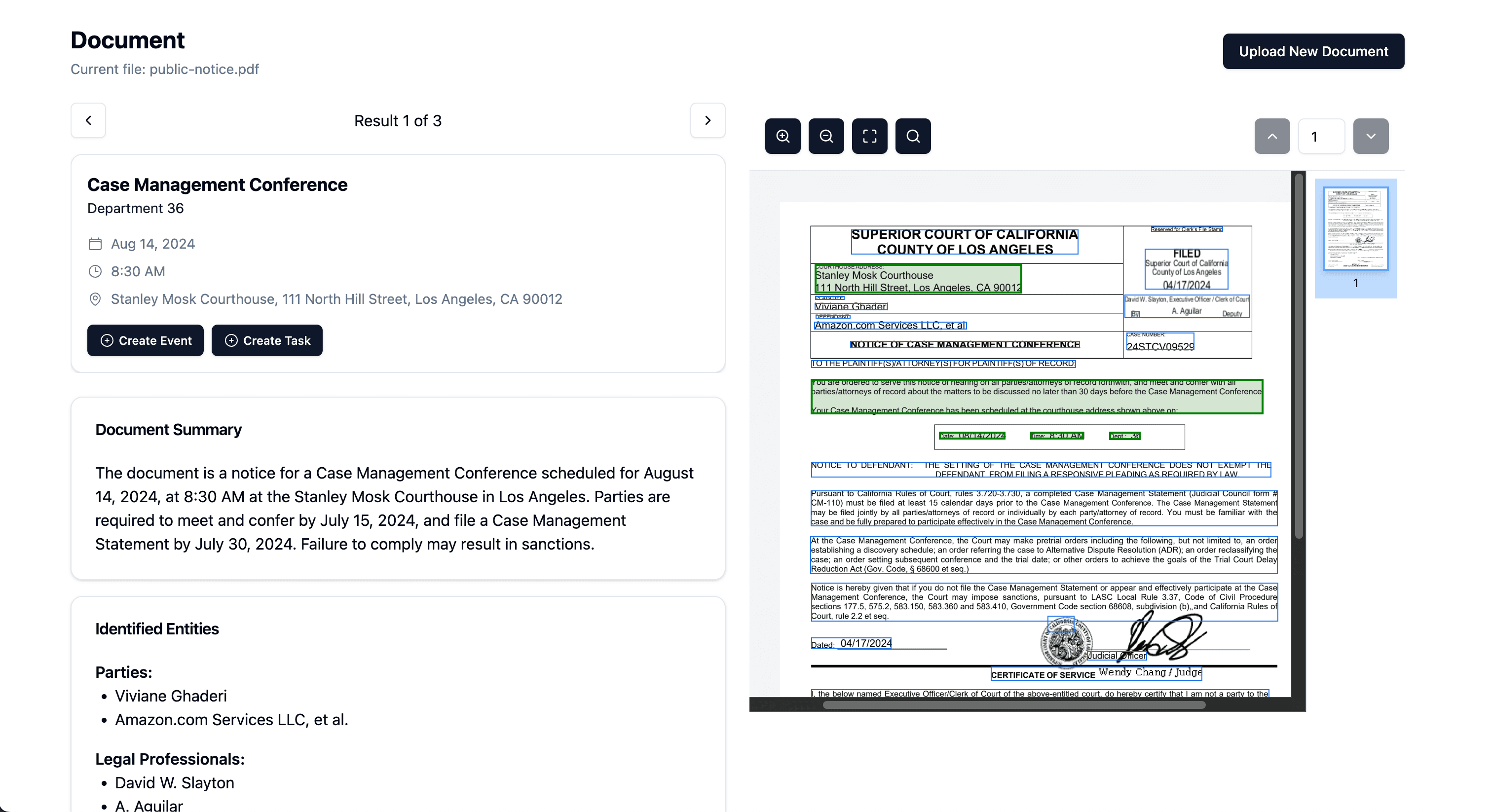
Every time a court notice arrives, someone at a law firm has to read through it, find the important dates and deadlines, then manually enter them into a calendar and task management system. On top of that, attorneys need to produce narrative summaries and medical documentation, each with different formatting requirements and compliance standards. For a single case, this can eat up hours. Multiply that across dozens of active cases, and you have attorneys spending more time on admin work than actual legal work. Deadlines get missed. Summaries are inconsistent. And the more a firm grows, the worse it gets.
Our Approach
Mapping the Work
Before writing a line of code, we studied how legal teams actually operate: reading court notices, extracting deadlines, writing case narratives, producing medical summaries. Each task had different requirements: speed, accuracy, compliance, tone. This audit shaped the entire platform design.
Choosing the Right Model for Each Job
This is where our approach differs. Instead of forcing one AI model to do everything, we matched each task to the model best suited for it. AWS for document reading and OCR, which is fast, reliable, and handles poor scan quality. GPT for the scheduling assistant, which is good at understanding context and pulling structured data like dates and tasks. Gemini for narrative summaries, which generates coherent, well-structured writing from case notes. Azure OpenAI on private cloud for medical summaries: same AI quality, running in a HIPAA-compliant environment.
Built to Fit How Attorneys Already Work
The biggest risk with any new tool is that nobody uses it. The platform plugs directly into the calendar, task management, and document systems law firms already have. Attorneys don't need to learn anything new. Deadlines show up where they already look. Summaries land where they already review them. One-click approval, and they're back to practicing law.
Results & Impact
Legal teams went from spending most of their day on paperwork to spending most of it on actual legal work. Document processing time dropped by 75%, and the same teams now handle three times the volume, with 99%+ accuracy on deadline extraction. Missed deadlines are essentially a thing of the past. The multi-model architecture means the platform isn't locked into any single AI provider. As models improve, the platform improves with them.
Technical Highlights
Technology Stack
AWS (Document Reading & OCR)
Handles the heavy lifting of reading documents: PDFs, scans, photos, handwritten notes. Fast, reliable, and works with poor-quality scans that other tools struggle with.
GPT (Schedule Assistant)
Powers the scheduling intelligence. Reads court documents, understands context, and extracts every deadline, hearing date, and action item into structured calendar events.
Gemini (Narrative Summaries)
Generates coherent, well-structured narrative summaries from case files and notes. Strong at producing professional prose that matches legal writing standards.
Azure OpenAI (Medical Summaries)
Same AI capability, but running on a private HIPAA-compliant cloud. Used exclusively for medical documentation where data privacy and compliance are non-negotiable.
